FreeFor everyone, every day
- All six interactive tools and picture guides
- Unlimited practice on every tool
- Timed tape measure, micrometer and caliper tests
- 49 calculators and 9 free printable charts
- A worksheet maker with answer keys
Free picture lessons and practice
Learn to read measuring tools with step by step pictures and fresh practice. Make free worksheets, or find a calculator for conversions, layouts and job math.
Free for everyone. No account, no sign up.

A clear place to start
Choose a picture to see its reading lesson below.
Start with the whole inch, count the small marks, then put the reading together.
Slide the drawing sideways if you need a closer look at the marks.
Read the full guide, then move into practice and testing.
More tools to learn: Speed square · Protractor · Combination square · Free printable ruler · En español
How it works
Every tool follows the same simple path.
Picture guides show one step at a time, with the part you are reading boxed and labeled.
Open the tape measure guideFresh drawings every time. Miss one and the picture shows where the answer came from.
Go to the practice studioTimed tests, like the measuring test at a job interview or trade class.
Take the tape measure testFree worksheets with answer keys, made new every time, plus full workbooks for practice on paper.
Make a free worksheetNo account. No catch.
Every lesson, practice set, timed test and calculator is free.
No sign up, no subscription.Paid for by a few ads, so it stays free.
Put that measurement to work
Convert a measurement, order material or check a job price. Find the right tool and see the steps beside the answer.
Browse all calculatorsThe complete guide
Measure Drill is a free place to learn how to read measuring tools. You move a real looking tape measure, ruler, micrometer, caliper or dial indicator, watch the reading change, and see every step of how it is worked out. Then you practice on fresh drawings until reading them is automatic. There is nothing to install and no account to make.
Most people who search for how to read a tape measure already own one. What they are missing is practice. Knowing that the small lines are sixteenths is not the same as glancing at a blade and saying "five and three eighths" without counting. That second part only comes from reading a lot of tapes, getting a few wrong, and seeing why. That is what this site is built for.
Reading a measuring tool is a skill of the eyes, like reading a clock. A video can tell you what each line means, but it cannot make you find the line yourself, under a little time pressure, and then show you exactly where you went wrong. Try, check and fix is the loop that makes a skill stick, and a video only gives you the first part of the explanation.
Here is how learning works on Measure Drill:
Every drawing is made from the same number used to mark your answer. A separate checker program reads every possible drawing of every tool back from its lines, so if the picture shows 5 3/8 inches, the answer key says 5 3/8 inches.
On most inch tape measures, every inch is split into 16 equal parts. The marks get shorter as the parts get smaller:
To read it, find the last whole inch number before the end of what you are measuring, count the small marks past it, and reduce the fraction. Six sixteenths past the 5 is 5 6/16, which you say and write as 5 3/8 inches. Eight sixteenths is 1/2, four sixteenths is 1/4, and two sixteenths is 1/8.
Past 12 inches, most tapes keep counting (13, 14, 15) and also mark the feet. A reading of 27 5/16 inches is the same as 2 feet 3 5/16 inches, because 24 inches make 2 feet. Many tapes also have red marks every 16 inches for wall studs, and small black diamonds every 19.2 inches for floor joists and trusses. The hook on the end slides a little on purpose, so the reading is right whether you hook it over an edge or push it against a wall. The tape measure guide shows all of this with a picture for every step.
An inch ruler uses the same marks as an inch tape measure, so if you can read one you can read the other. The one difference: on many rulers the zero is not at the very end, so always measure from the zero line. The ruler guide covers inch and metric rulers.
Metric is simpler. The numbers are centimeters, and each small line is one millimeter, with a longer line at the half centimeter. Ten millimeters make one centimeter, so 4 centimeters and 7 small lines is 47 millimeters, or 4.7 centimeters. There are no fractions to reduce.
A micrometer measures to a thousandth of an inch, roughly a third of the thickness of a human hair. An inch micrometer adds three numbers. The numbers on the sleeve are tenths of an inch, 0.100 each. Each small line between them is 0.025 inch, one full turn of the thimble. The thimble has 25 lines, and each one is 0.001 inch. So a micrometer showing 3 on the sleeve, two small lines after it, and thimble line 22 on the reference line reads 0.300 + 0.050 + 0.022 = 0.372 inch.
Vernier micrometers add a fourth decimal place, ten thousandths, read from the line that lines up exactly. A 1 to 2 inch micrometer adds 1.000 inch to everything. Metric micrometers use whole and half millimeters on the sleeve and 50 thimble lines of 0.01 millimeter. The micrometer guide walks through all of them with labeled pictures, starting with the parts and how to measure with the ratchet.
Calipers measure the outside of a part, the inside of a hole and the depth of a hole with the same tool. A dial caliper is the easiest to read: take the inches and tenths from the bar, then add the dial, where each mark is 0.001 inch and one turn is 0.100 inch. A bar reading of 1.200 plus 37 on the dial is 1.237 inches.
A vernier caliper takes more care. Read the main scale up to the vernier zero, then find the one vernier line that lines up exactly with a line on the main scale. That line is the thousandths. Metric verniers read to 0.1, 0.05 or 0.02 millimeter the same way. The caliper guide shows how to hold it for outside, inside and depth measurements.
A dial indicator shows how far its plunger moves. Each mark on the big dial is 0.001 inch, and the small turn counter counts full turns of 0.100 inch. Three turns and the big needle on 47 is 0.347 inch. Machinists use it to check how much a shaft wobbles, called runout, which is the highest reading minus the lowest. See the dial indicator guide.
Once you can read the measurement, the next question is usually what to do with it. The calculator directory covers feet and inches math, fractions to decimals and millimeters, finding the center, equal spacing, area and volume, paint, drywall, tile, flooring, concrete, gravel and mulch, board feet and cut lists, plus unit converters. Every calculator shows its working and keeps fractions exact, so a cut list adds up to the inch, and each one links back to the lesson behind it.
Every online lesson, calculator, worksheet, practice set and timed test on Measure Drill is free, with no account. If you teach a class or just like practicing on paper, there are printable workbooks with answer keys available as optional paid downloads.
Before you pick up a tool
New to measuring? You’re in the right place.
On a standard inch tape the longest lines are whole inches, then half inches, quarter inches and eighth inches. The shortest lines are sixteenths of an inch. Some tapes also mark thirty seconds for the first 12 inches.
Find the last whole inch before the end, count the shortest marks after it (each is 1/16 inch), then reduce the fraction. Six marks is 6/16, which is 3/8.
The red marks every 16 inches show standard wall stud spacing. The black diamonds every 19.2 inches are for floor joists and trusses, which puts five of them in every 8 feet.
Its spindle has 40 threads per inch, so one turn of the thimble moves it 0.025 inch. The thimble is divided into 25 lines, so each line is 0.001 inch.
No. Start with the tape measure or ruler guide. Each tool has a lesson, an interactive reading and practice at different levels.
Yes. The layout adapts to your screen. Tool drawings can scroll sideways so you can still read the small marks.
No. Everything on Measure Drill is free and works without an account. The practice studio saves your progress in this browser.
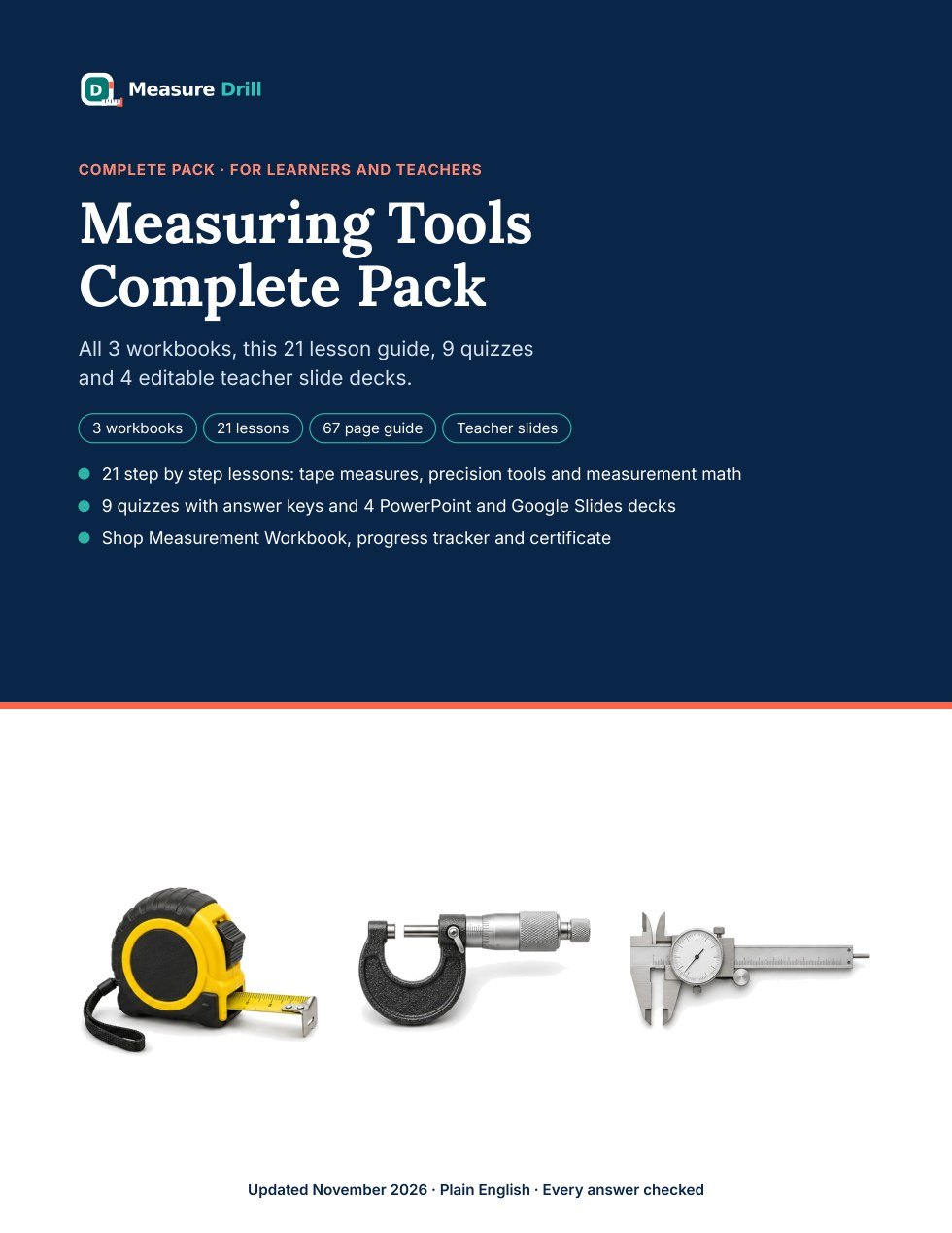
Yes. The printable workbooks have the same picture lessons, hundreds of readings and every answer key. The Complete Pack has all three workbooks, a 21 lesson guide with measurement math, 9 quizzes and teacher slides.
No. These are independent practice exercises. Your score helps you see what to work on; it is not a professional certification.
Yes. The calculator directory includes unit conversions, fractions, layouts, material quantities, woodworking, business math and work hours. The conversion lessons explain the measurement methods before practice and testing.
Both are available for tape measures, rulers, micrometers and vernier calipers. Dial indicators include inch and metric levels. The dial caliper practice uses inches.
There’s a good eye in there.